In this article
Why the building is part of the care
Most care homes in Havering are converted houses: large Victorian or Edwardian properties with rooms added over decades. Some are excellent. But the building sets limits on what staff can do, and families should look at it with the same attention they give to the staff. Moreland House on Manor Avenue was built in 2014 as a nursing home, with 50 rooms over three floors, 49 of them en-suite, and it is the flagship of the Abbey Total Care group. This is what that design makes possible.
Corridors, lifts and floors
Older buildings can have narrow corridors, steps between levels and lifts added later that may not take a bed. A purpose-built home can be planned without those limits. Moreland House, purpose-built in 2014, has wide corridors and accessible lifts. It also has a dining room, communal lounges and a quiet lounge.
Bedrooms and bathrooms
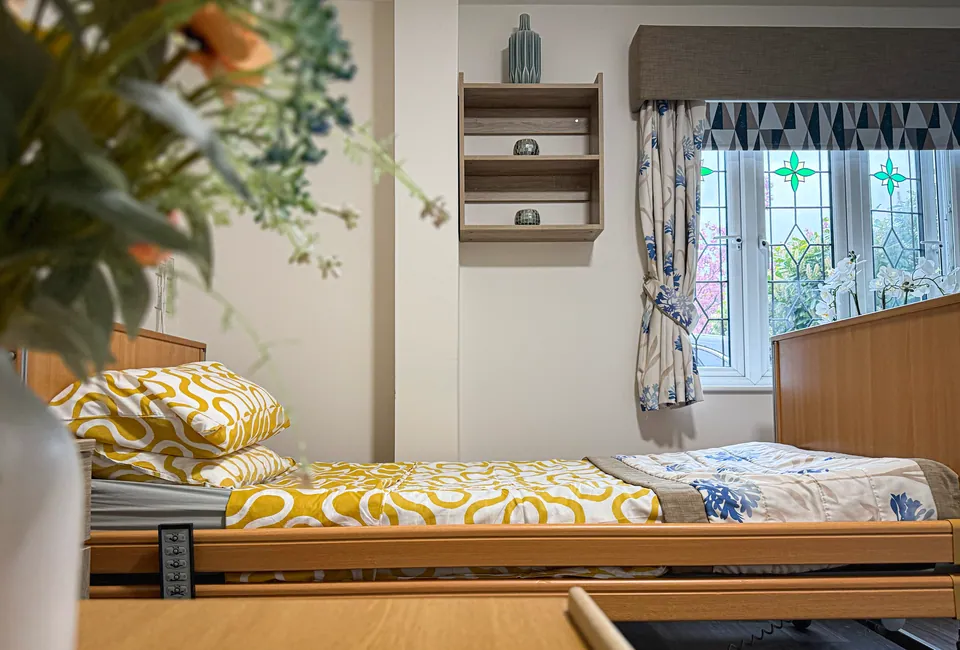
An en-suite bathroom is more than privacy. For a person with dementia, the toilet being close by can reduce confusion and falls. For a person with a catheter, a stoma or continence needs, it preserves dignity. For a nurse, it means care can be given without moving the person down a corridor. At Moreland House 49 of the 50 rooms are en-suite. Ask about bringing photographs, bedding and small furniture so that the room feels like the person's own.
Bathing
Many older people cannot use a shower safely, and a standard bath is impossible for someone who cannot step over the side. Moreland House has hydraulic and hydrotherapy baths for assisted bathing and complex clinical needs: the resident is lowered in and lifted out, so a proper bath stays possible when a standard one is not. Ask any home you visit how residents are bathed, and how often.
Gardens and outside space
A garden that residents can get into easily is a good sign in any home. It needs level access, somewhere to sit in shade, something to look at, and a boundary that keeps people safe without feeling like a wall. Moreland House has a fountain, a gazebo, a patio and a landscaped lawn outside. Ask how residents get out to them.
Salons, treatment rooms and visiting space
A salon on site means a resident can have their hair done in the building rather than needing a relative to take them out; for many residents it is the appointment they look forward to all week. Treatment rooms allow visiting chiropodists, opticians and GPs to see residents privately. Quiet spaces where a family can sit with a relative away from the main lounge matter at the end of life, and a purpose-built home can provide them without improvising.
What a purpose-built home does not guarantee
A new building does not make a good home; staff do. The questions that matter are the same in any building: who is the registered manager, how many nurses and carers are on duty by night, what the latest Care Quality Commission report says, how falls and infections are reported to families, and whether the home can care for a person to the end of life. At Moreland House the building is there to let the staff do their jobs well, not to replace them.
Using the building well: what residents do here
Residents at Moreland House are admitted from the age of 60 for residential care, nursing care, dementia care, rehabilitation after a hospital stay, respite and palliative care. A typical day starts in the person's own time, with breakfast over a window, an activity mid-morning, lunch on the floor's dining area, a quieter afternoon in the lounge or the garden and a slow evening. The salon, the hydrotherapy baths and the gazebo are part of the week rather than occasional treats.
Questions to ask about any building
- Is every bedroom en-suite, and how many have a level-access shower or wet room?
- Can a resident in a wheelchair reach every lounge, the dining room and the garden without help?
- How wide are the corridors and doors, and can two wheelchairs pass?
- Is there an assisted bath as well as showers, and how often is it used?
- Is the garden secure enough for a person with dementia to use it unaccompanied?
- Where do residents actually spend the day: in their rooms, or in the shared spaces?
- Is there somewhere private for a family to meet a nurse or sit with a dying relative?
The last two questions matter most. A beautiful building with every resident in their room all day is not working; a plain one with the lounge full at eleven in the morning is.
Visiting Moreland House
Moreland House is at 5 Manor Avenue, Hornchurch RM11 2EB, a quarter of a mile from Gidea Park station on the Elizabeth line and close to Emerson Park, Upminster and Romford. Ask to see a room, a bathroom, the lift, the garden and a lounge at a mealtime; the building answers many questions before you ask them. Book through the tour form or call 01708 442654.
Where to go next
Sources: Care Quality Commission · Care homes (NHS) · Choosing a care home (Age UK)
A question about care? Our team is here to help.
Talk to our team